
Hi, I’m Daniel Russo, a senior appliance repair technician with over a decade of experience working in homes throughout Bergen County. As the weather starts to cool down here in the Hackensack area, I know many of us are firing up our ovens for the first time in months. There’s nothing quite like the smell of a freshly baked cake or a hearty roast on a crisp September evening. But what happens when that cake comes out with burnt edges and a gooey, undercooked center? Or when your famous cookies are taking an extra 10 minutes to bake? It’s incredibly frustrating and can ruin a perfectly good meal.
If you're experiencing inconsistent results from your oven, you're not alone. This is one of the most common issues my team and I see, especially as baking season kicks off. An oven that can't maintain a steady temperature is more than just an annoyance; it’s a sign that something isn't working correctly. Let’s walk through the common signs of this problem and what might be causing it.
Common Signs and Symptoms
Recognizing the problem is the first step. An oven that struggles with temperature regulation will leave you plenty of clues. You might be dealing with significant oven temperature swings if you notice:
- Uneven Cooking Results: This is the most obvious sign. You might find that casseroles are hot on top but cool in the middle, or that one side of a sheet of cookies is perfectly golden while the other is pale. This is a classic example of what bake unevenly causes.
- Extended or Shortened Cooking Times: Are your trusted recipes suddenly taking much longer to finish? Or, conversely, are things burning before the timer even goes off? When your oven not holding temp, it can either run too cool or overheat, throwing off your cooking times dramatically.
- Visible Temperature Fluctuations: If you use a separate, reliable oven thermometer (which I highly recommend!), you might see the temperature dip 50 degrees or more below your set point, then overshoot it as it tries to compensate.
- Excessively Long Preheat Times: While all ovens take time to heat up, an oven with a faulty component might take 30 minutes or more to reach the desired temperature.
- The Preheat Light Cycles On and Off Constantly: It's normal for the light to cycle as the oven maintains heat, but if it's happening every minute or two, it's a sign the oven is struggling to hold a consistent temperature.
What Causes This Problem
An oven is a system of interconnected parts, and when one fails, it can throw the whole system off balance. Here are some of the most common culprits I find when diagnosing an oven that won't hold its temperature.
- A Worn-Out Door Gasket: This is the rubber or mesh seal around the oven door. Over time, it can become brittle, torn, or compressed. A bad gasket allows hot air to escape, forcing the oven to work harder to maintain temperature. This constant heat loss is a primary driver of oven temperature swings. Take a quick look at your gasket - if you see any visible damage or feel hot air leaking out, it’s likely time for a replacement.
- A Faulty Temperature Sensor: This small probe, usually located at the back of the oven cavity, reads the internal temperature and sends that information to the control board. If the sensor is failing or has shifted to touch the oven wall, it will send inaccurate readings. The oven might think it's hotter or cooler than it actually is, causing it to heat incorrectly.
- A Failing Oven Thermostat: In older, non-digital ovens, the thermostat is a mechanical switch that regulates power to the heating elements. Clear oven thermostat symptoms include the oven not heating at all, overheating to dangerously high temperatures, or failing to cycle on and off properly to maintain heat. This is a critical component for temperature regulation.
- Malfunctioning Heating Elements: Most electric ovens have two elements: the bake element on the bottom and the broil element on top. For even baking, both need to function correctly during the preheat cycle, with the bake element doing most of the work during baking. If the bake element is burned out (you might see blistering or a visible break), the oven will rely solely on the broil element, leading to burnt tops and undercooked bottoms.
- A Defective Control Board: The electronic control board is the brain of a modern oven. It interprets signals from the temperature sensor and tells the heating elements when to turn on and off. If a relay on the board is stuck or fried, it can cause the oven to either overheat or not heat enough. This is a more complex and expensive repair.
- Improper Oven Calibration: Sometimes, the oven's thermostat is simply out of sync with the actual temperature. If you find your oven is consistently 25 degrees hotter or cooler than the display shows, it may just need to be recalibrated. While some user manuals provide instructions for this, the process can be tricky, and an incorrect adjustment can make the problem worse.
- Convection Fan Issues: If you have a convection oven, the fan's job is to circulate hot air for fast, even cooking. If the motor fails, you lose that circulation. Your oven will still heat, but it will revert to behaving like a conventional oven, which can lead to uneven results and longer cook times if you’re following a convection recipe.
- Power Supply Problems: This is especially relevant for the many electric ranges in the Hackensack area. Electric ovens require a steady 240 volts to operate correctly. Fluctuations in your home's voltage can impact performance. In some of the beautiful, older homes in nearby towns like Dumont, which often feature post-war 1940s construction, the original wiring may not be as robust as in newer builds. If your oven temperature problems seem worse during peak evening hours when energy demand is high, it could be related to the power supply.
When to Call a Professional
As a homeowner, there are a few things you can safely check. You can visually inspect the door gasket for damage and ensure you aren't blocking air vents with foil. You can also place an oven thermometer inside to confirm if you have a problem. However, most causes of an oven not holding temp involve electrical components.
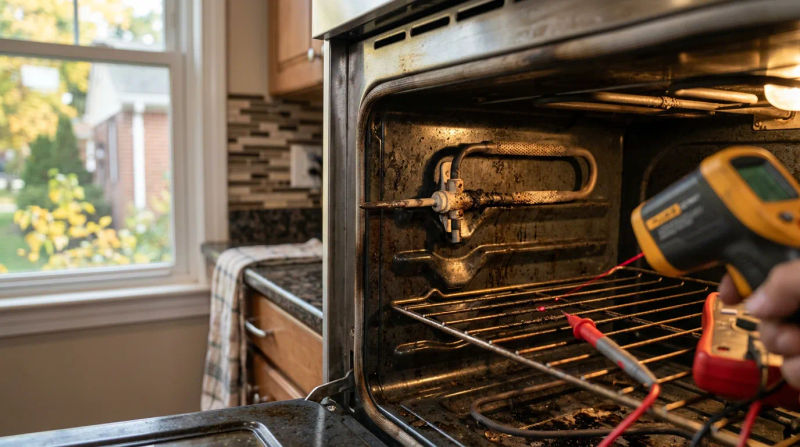
For your safety, any repair that involves diagnosing or replacing parts like the temperature sensor, heating elements, thermostat, or electronic control board should be left to an experienced professional. These repairs require working with live electrical circuits and specialized diagnostic tools. Attempting a DIY repair without the proper knowledge can lead to further damage to the appliance or, far worse, personal injury. My team and I have the training and equipment to safely diagnose the root cause and replace the correct part efficiently.
Conclusion
An oven that delivers inconsistent results can take all the joy out of cooking and baking. The problem rarely fixes itself and often gets worse over time, potentially leading to more significant and costly repairs down the line. Whether the culprit is a simple door gasket, a faulty temperature sensor, or a failing bake element, identifying the issue is key.
Pay attention to the signs - unevenly baked food, fluctuating cooking times, and long preheat cycles are all indicators that your oven needs attention. Acting early can save you from countless frustrating meals and ensure your appliance is ready for all the holiday baking and family dinners to come.
If you notice any of these signs, contact a local Appliance Repair professional for an inspection. They can accurately diagnose the problem and get your oven back to performing reliably and safely.